

close
Choose Your Site
Global
Social Media
Views: 0 Author: Site Editor Publish Time: 2026-08-25 Origin: Site


Equipment downtime and non-compliant production in continuous extrusion processes rapidly degrade your bottom line. Manufacturers cannot afford unexpected halts when running continuous lines. Maintaining your equipment requires precise thermal management, mechanical alignment, and careful material handling oversight. You must tightly control these variables to meet stringent electrical standards like UL and NEC. This guide outlines the standard operating procedures, preventative schedules, and ROI-focused evaluation frameworks for managing operations. You will discover practical ways to reduce scrap and improve output quality. We detail specific daily, weekly, and monthly maintenance steps to keep your line running smoothly. You will also learn how to troubleshoot common defects and decide whether to overhaul aging equipment. These insights will help you maintain high overall equipment effectiveness and protect your production margins.
Success Criteria: Effective maintenance reduces PVC resin waste, eliminates conduit pinhole defects, and extends the lifespan of the extruder screw and barrel.
Cost Realities: Reactive maintenance strategies historically yield a 15-20% higher total cost of ownership (TCO) compared to scheduled, condition-based approaches.
Decision Matrix: Escalating maintenance frequencies or recurring heating zone failures are primary indicators that it is time to evaluate upgrading your current conduit PVC coating machine.
Unplanned downtime costs manufacturers heavily. You lose yield, generate excess scrap, and pay emergency labor rates. Extrusion processes demand continuous operation. Any sudden stop disrupts the delicate thermal balance inside the barrel. Operators must purge degraded materials before restarting. This wastes expensive PVC resin. You also lose valuable production hours. Managing your mechanical assets properly prevents these expensive interruptions.
Material efficiency directly influences your profit margins. Poor die alignment causes immediate problems. Inconsistent heating also leads to uneven wall thickness. These mechanical faults result in wasted PVC compound. You end up producing rejected batches. Proper die centering ensures material flows evenly over the metal core. Consistent heat keeps the polymer viscosity stable. When you ignore these factors, raw material costs escalate quickly.
Compliance and quality assurance remain critical for industrial applications. Non-uniform PVC coatings often fail NEMA RN-1 or UL-6 standard tests. A failed inspection risks contract loss. Clients may disqualify you as an approved vendor. Electrical contractors rely on consistent coating thickness for corrosion resistance. Thin spots in the plastic layer expose the underlying metal to rust. Pinholes compromise the entire protective barrier. You must prioritize equipment upkeep to maintain product certification.
Manufacturers should target an Overall Equipment Effectiveness (OEE) above 95 percent. You achieve this through proactive component management. Tracking availability, performance, and quality reveals hidden inefficiencies. A well-maintained conduit PVC coating machine consistently hits these OEE targets. Regular servicing keeps availability high and reduces scrap. It guarantees consistent performance across different product sizes. Protect your investments by shifting away from run-to-failure habits.
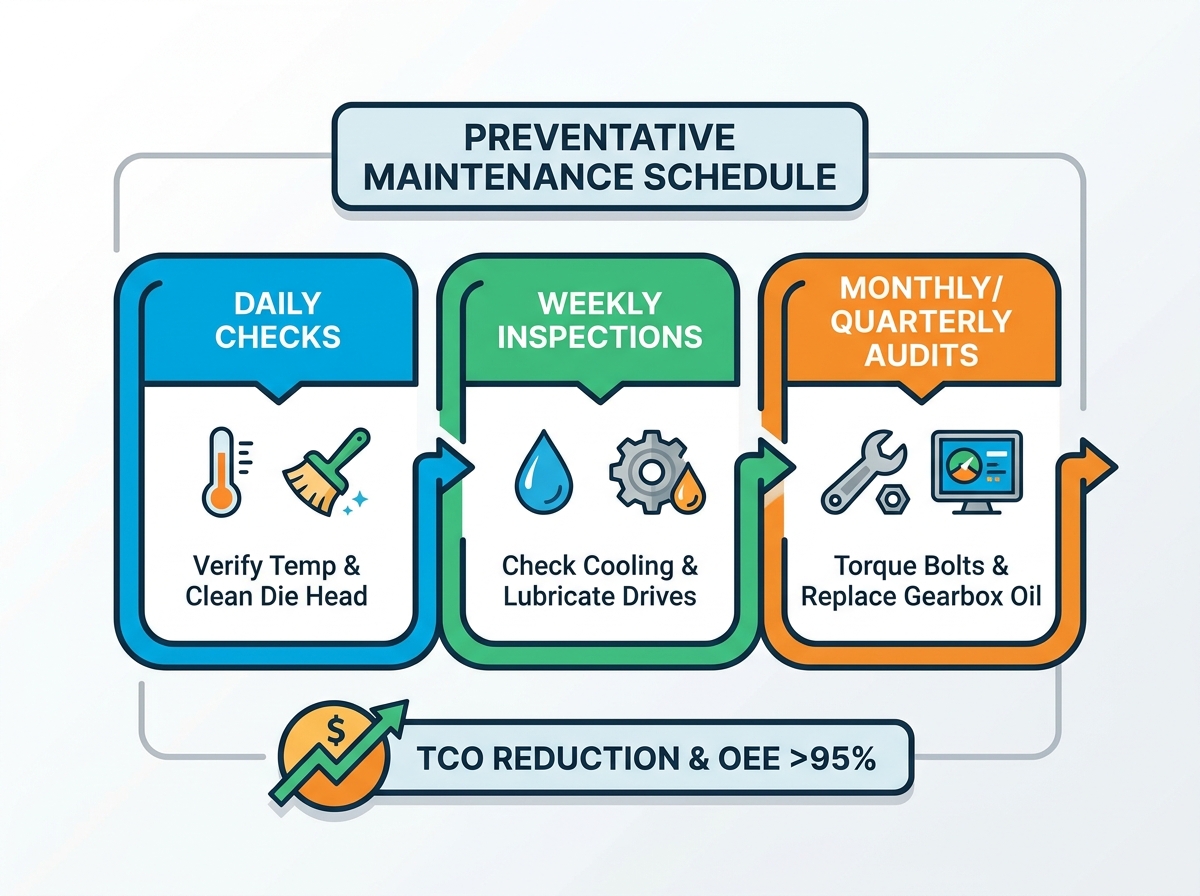
Industrial teams are moving away from reactive fixes. They now prefer structured preventative and predictive frameworks. Waiting for a component to break destroys production schedules. A proactive approach categorizes tasks based on time and machine condition. This keeps operations smooth and predictable. You can categorize your solutions into three main strategies.
Preventative (Time-Based) Maintenance: This involves the scheduled replacement of wear parts. You change components before failure occurs. Extruder screens require frequent swaps to maintain melt pressure. Caterpillar belts on the haul-off unit wear down over time. Replacing them periodically prevents conduit slippage. Routine oil changes in the main gearbox prevent gear stripping. Time-based schedules give you baseline protection against sudden breakdowns.
Predictive (Condition-Based) Maintenance: This strategy monitors actual machine health. You utilize thermal imaging on electrical cabinets and gearboxes. Hot spots indicate loose connections or failing bearings. Vibration analysis on motors helps identify early signs of mechanical degradation. Sensors detect frequency shifts long before a bearing seizes. You order parts only when the condition dictates. This maximizes component life while avoiding unexpected failures.
Software Integration: Modern maintenance requires robust data tracking. Teams leverage Computerized Maintenance Management Systems (CMMS). These platforms track the mean time between failures (MTBF). You can monitor critical heating zones and drive motors. The software alerts you when specific parts approach their statistical end of life. Integrating your PLC data into a CMMS provides real-time health dashboards.
Implementing these approaches requires a culture shift. Operators and technicians must communicate daily. Data must guide your purchasing decisions. Over time, predictive methods lower your spare parts inventory. You only stock items nearing their replacement windows. This frees up operational capital.
Consistency keeps extrusion lines profitable. A tiered standard operating procedure (SOP) assigns clear responsibilities. It divides tasks into daily, weekly, and monthly intervals. Operators handle daily checks. Maintenance technicians manage deeper weekly and monthly audits. This division of labor ensures nothing gets overlooked.
Verify heating zone temperatures closely. Calibrate them against specific PVC compound requirements. Different formulations demand unique heat profiles.
Clean the extrusion die head thoroughly. Inspect the sizing sleeve to prevent material buildup. Burnt resin on the die lip causes scratch marks on the final product.
Inspect the haul-off caterpillar tension. Incorrect tension crushes the metal conduit. Too little tension causes slippage and uneven coating weights.
Check hopper material levels. Ensure auto-loaders function properly to avoid running the barrel dry.
Examine cooling trough water quality. Clean the filtration systems to prevent blockages. Dirty water scales the cooling pipes and reduces heat transfer.
Inspect the pre-heating unit. Whether using induction or resistance, ensure consistent energy transfer. A failing pre-heater leads to poor plastic adhesion.
Lubricate mechanical drive chains. Grease all guide rollers to prevent binding. Smooth movement ensures the conduit travels without jerking.
Test safety interlocks and emergency stop buttons. Verify protective guards remain securely fastened.
Deeper audits prevent catastrophic mechanical failures. You must perform torque checks on extruder barrel bolts. Thermal expansion causes these fasteners to loosen over time. Inspect all electrical terminal connections inside the main panel. Loose wires generate heat and cause sudden shutdowns. Drain, flush, and replace the gearbox oil quarterly. Metal shavings in the oil indicate severe gear wear. Finally, conduct sensory diagnostic tests on the Programmable Logic Controller (PLC). Watch for signal drift in the thermocouple inputs. Recalibrate any sensors providing erratic readings.
Even well-maintained machines occasionally produce defects. Quick diagnosis minimizes scrap. Operators must understand the relationship between mechanical functions and product quality. Identifying root causes prevents recurring problems. You must observe the symptoms, diagnose the machine, and take immediate corrective action.
Uneven PVC wall thickness often plagues continuous runs. Misaligned dies frequently cause this issue. Fluctuating extruder RPM also creates uneven pressure. Uneven raw conduit feeding changes the line speed momentarily. To fix this, you must re-center the tooling die. Verify the Variable Frequency Drive (VFD) stability. A failing VFD causes the screw speed to surge. Ensure the payoff reel maintains constant back-tension on the raw conduit.
Poor adhesion or surface pinholes ruin product viability. Inadequate metal conduit pre-heating is a major culprit. If the metal is cold, the PVC shrinks away quickly. Moisture contamination in the PVC hopper also causes pinholes. Water flashes to steam inside the hot barrel. This steam creates tiny bubbles in the coating. You must audit the pre-heater function. Ensure your desiccant dryers function optimally. Check the dew point of the drying air regularly.
Risk mitigation requires excellent record keeping. Document all defect types in a central log. This helps you identify recurring machine deficiencies. You stop treating just the symptoms. A pattern of moisture defects might point to a failing dryer compressor. A history of uneven walls might indicate worn die threads. Tracking these metrics turns raw data into actionable maintenance intelligence.
Defect Symptom | Probable Root Cause | Corrective Action Required |
|---|---|---|
Uneven Wall Thickness | Misaligned die or surging RPM | Re-center die bolts; check VFD stability. |
Surface Pinholes | Moisture in PVC compound | Audit desiccant dryer dew point. |
Poor Adhesion | Inadequate conduit pre-heating | Test induction heater output. |
Scratches on Surface | Burnt material on die lip | Purge system and clean tooling. |
Product Slippage | Worn caterpillar belts | Replace haul-off traction belts. |
Equipment does not last forever. Eventually, routine maintenance cannot overcome basic mechanical fatigue. You must evaluate whether to overhaul your existing setup or buy new equipment. Assessing these dimensions prevents you from pouring money into obsolete assets. You must determine if repair costs exceed the depreciated value of the equipment.
Several signs indicate it is time to upgrade. Extruder screw and barrel wear is a primary factor. When wear exceeds manufacturer tolerances, consistent plasticization becomes impossible. The melt pressure drops. Operators compensate by raising RPMs, which degrades the PVC. Legacy PLC systems also present major hurdles. Unsupported software creates cybersecurity risks. It leaves compliance blind spots because older systems cannot log historical quality data. Disproportionate energy consumption per foot of coated conduit also signals obsolescence. Older drives and worn heaters draw excessive amperage to do the same work.
Evaluate new equipment based on specific feature-to-outcome metrics. Modern technology solves legacy problems automatically. Prioritize features like automated die centering. This eliminates human error during setup. Look for integrated inline wall-thickness measurement. Laser sensors ensure every foot meets strict UL tolerances. Predictive maintenance sensors should come standard. Factory-installed vibration and thermal sensors connect directly to the new PLC.
Vendor due diligence remains your final protective step. Demand transparent MTBF data for all major components. Require clear Service Level Agreement (SLA) terms. You need guaranteed OEM parts availability for at least a decade. Ask about remote diagnostic support capabilities. A strong vendor will connect to your machine securely to help troubleshoot software faults. Make sure their technical support team understands your specific continuous production constraints.
Rigorous maintenance directly correlates with high production yields. Taking care of your extrusion line ensures continuous product compliance. It protects your operational profitability against unplanned downtime. Transitioning from reactive fixes to predictive schedules requires discipline but pays massive dividends. By mastering daily checklists and deep monthly audits, you extend the life of your mechanical assets significantly. Tracking defect data helps you spot failing components before they ruin production runs.
Audit your current maintenance logs against the tiered schedules provided. Check if your operators consistently monitor moisture and temperature parameters. Evaluate your aging equipment for excessive energy use or failing legacy controllers. If you notice recurring failures or struggling heating zones, do not wait for a complete breakdown. It is highly recommended that you consult with an equipment specialist to determine if your current setup requires a major overhaul or a full system replacement.
A: The typical lifespan ranges from 10,000 to 15,000 operational hours. This depends highly on the abrasiveness of the PVC compound used. Adherence to proper heating protocols also affects longevity. Cold-starting the machine drastically reduces screw life by causing severe mechanical shear and metal wear.
A: A baseline calibration is recommended quarterly. However, high-volume facilities should perform comparative thermocouple checks monthly. Ensuring accurate temperature readings prevents PVC degradation and maintains optimal polymer flow rates through the extrusion die.
A: Yes. Adding vibration and thermal sensors to legacy motors and gearboxes prevents catastrophic failures. Early warnings allow you to replace cheap bearings before they destroy expensive gear teeth. However, sensors will not correct core mechanical wear already present inside the extruder barrel.


