

close
Choose Your Site
Global
Social Media
Views: 0 Author: Site Editor Publish Time: 2026-08-14 Origin: Site


Transitioning from bare flexible metal conduit (FMC) to liquid-tight flexible metal conduit (LFMC) demands a strategic manufacturing shift. You must move your operational focus from metal forming directly to polymer extrusion. This transition requires precision equipment and tight process controls.
Inconsistent coating applications cause severe operational headaches on the factory floor. Poor polymer adhesion leads to compromised IP ratings and out-of-spec outer diameters (OD). Manufacturers failing to control this extrusion process often miss strict regulatory standards. These missed standards include crucial industry benchmarks like UL 360 and NEMA RN.
We will explore the critical hardware components of a commercial-grade coating system. You will get a detailed breakdown of each machine module from the pay-off to the final coiler. This guide establishes clear evaluation criteria for production engineers. It also helps procurement teams comparing various equipment vendors.
Tension management between the pay-off and haul-off dictates the structural integrity of the underlying metal core during extrusion.
Extruder screw design and crosshead precision are the primary drivers of coating concentricity and material versatility (PVC, TPU, LSZH).
Inline cooling and synchronization directly dictate maximum continuous line speed and overall yield without deforming the jacket.
Evaluating a flexible conduit coating line requires looking beyond baseline output metrics to assess changeover times, ease of maintenance, and integration footprint.
The extruder represents the most capital-intensive component in your setup. Its mechanical configuration determines long-term profitability. A robust design allows you to run multiple jacket materials easily. A basic setup restricts your production entirely to standard PVC.
You must evaluate Length to Diameter (L/D) ratios carefully. Proper L/D ratios ensure continuous and uniform plasticization. High ratios improve melt consistency across long production runs. You need specific screw geometries for processing complex materials. High-viscosity or heat-sensitive compounds behave differently. Low Smoke Zero Halogen (LSZH) requires specific shear rates. Standard PVC handles higher shear forces easily. LSZH will burn or cross-link prematurely if subjected to standard PVC screw profiles.
Jacket Material | Screw Geometry Focus | Temperature Sensitivity | Typical Application |
|---|---|---|---|
Standard PVC | High shear, rapid melting | Low to Moderate | General commercial wiring |
LSZH | Low shear, gradual compression | High (Burns easily) | Confined spaces, transit systems |
TPU (Polyurethane) | Medium shear, high mixing | Moderate | High-abrasion industrial environments |
The crosshead maintains absolute concentricity over the metal core. It distributes molten polymer evenly around the corrugated surface. Uneven distribution causes weak spots and immediate QA failures. Integrated vacuum systems play a crucial role here. The vacuum pulls the polymer tight against the metal profile. This negative pressure prevents jacket slippage during field installation. A slipping jacket ruins the mechanical integrity of the final product.
Multi-zone PID temperature control prevents dangerous polymer degradation. You need precise heating during initial ramp-up. You also need stability during continuous operation. Variations in barrel temperature alter the polymer viscosity. Changing viscosity directly impacts the final outer diameter. Reliable PID controllers make micro-adjustments automatically. They keep the melt flow perfectly consistent.
Bare metal conduit reacts poorly to sudden mechanical stress. It elongates and unspools quickly if mishandled. Improper pay-off mechanisms cause frequent line stoppages. They compromise the entire production run.
Passive stands rely entirely on the haul-off for pulling force. This creates dangerous tension spikes across the line. Motorized pay-offs utilize responsive dancer arms. They act as mandatory components for stable line speeds. The dancer arm absorbs tension fluctuations instantly. It signals the pay-off motor to speed up or slow down. You must manage inertia carefully during start-stop cycles. Proper inertia management prevents stretching the fragile metal core.
Inline induction pre-heating prepares the metal core perfectly. It raises the core surface temperature before entering the crosshead. This thermal preparation improves polymer adhesion significantly. It also bakes off internal moisture effectively. Trapped moisture causes blistering in the final extruded jacket.
Common Mistake: Skipping the pre-heater in humid environments.
Result: Micro-bubbles form under the jacket, failing electrical spark tests.
Best Practice: Keep induction coils clean and calibrated to the specific core diameter.
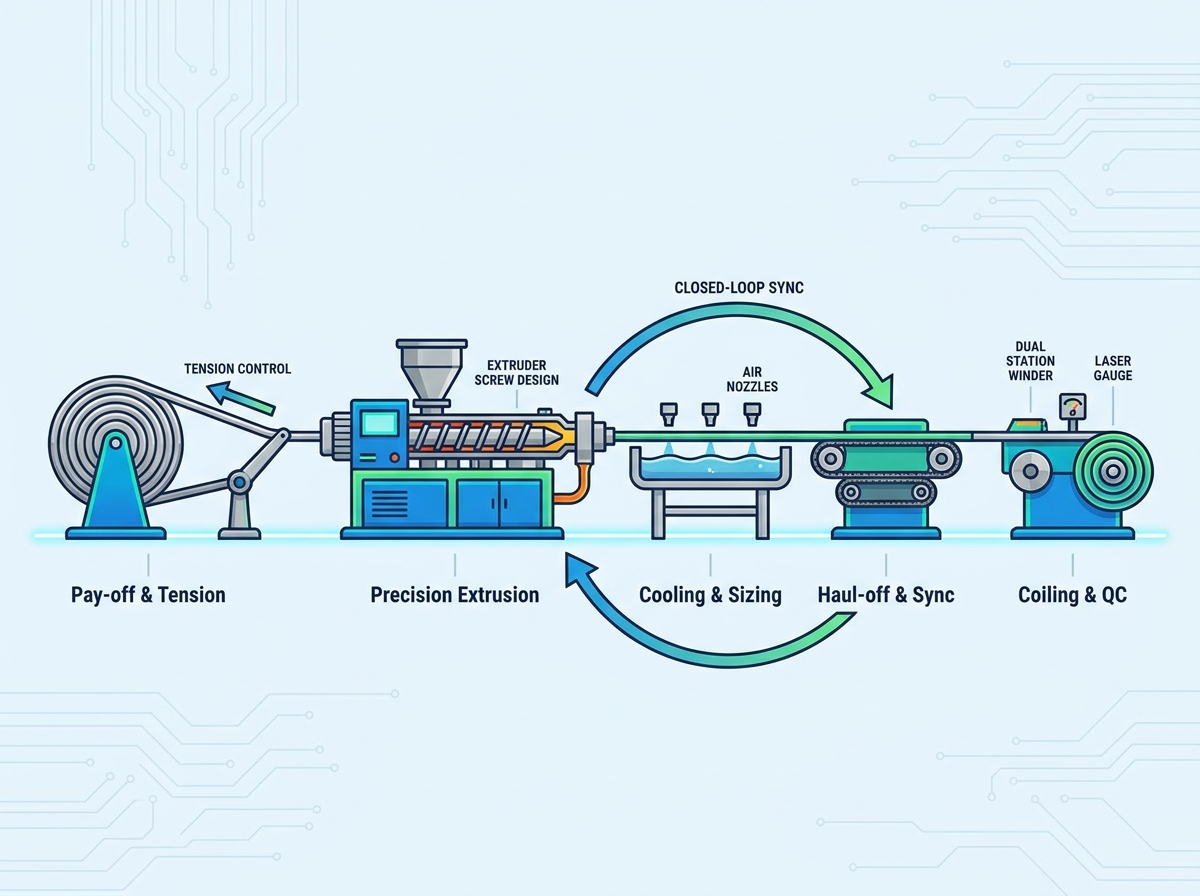
Jacket thickness must remain strictly within specified tolerances. The final OD dictates compatibility using standard liquid-tight fittings. Inadequate cooling creates structural ovality. Ovality guarantees fitting failures in the field.
Cooling requires a carefully phased thermal approach. You should use warm water in the initial cooling zones. Warm water prevents rapid shrinkage and thermal shock. It eliminates surface defects and stress cracking completely. Follow this initial stage using high-pressure chilled water zones. Chilled water provides the final structural setting. It locks the polymer into its permanent shape quickly. This multi-stage process ensures a perfectly round conduit.
Water cannot remain on the finished jacket surface. Air wipe configurations sit just before the haul-off unit. They blast residual moisture away using compressed air. Moisture interferes heavily during inline inkjet printing. It also causes slipping inside the haul-off belts. A high-quality flexible conduit coating line integrates these drying systems seamlessly. This integration guarantees clear printing and solid traction.
The traction system pulls the coated conduit forward steadily. It must match the exact speed of the extruder output. Desynchronization ruins the product instantly. It leads to thin spots or severe line buckling.
Belt haul-offs provide superior surface contact. Variable frequency drives (VFD) make vital micro-adjustments in line speed. These adjustments keep tension uniform across the entire line. Pneumatic tension controls govern the haul-off belts. They grip the coated conduit firmly. They do so without crushing the sensitive corrugated profile. Mechanical grips often apply too much localized pressure. Pneumatic systems distribute the gripping force evenly.
Set the pneumatic pressure based on the conduit diameter.
Align the belts to prevent lateral twisting.
Engage the VFD closed-loop control system.
Monitor encoder feedback for speed variations.
The extruder RPM and haul-off speed require tight integration. Closed-loop control systems achieve this seamlessly. Encoders measure the actual line speed constantly. The PLC compares this data against the extrusion output. It automatically corrects any minor drift. This continuous communication keeps yield rates high. It also minimizes scrap during production ramp-ups.
Extrusion speed faces a hard physical limit eventually. It stops at how fast you can spool the finished product. Poor winding bottlenecks the entire manufacturing operation.
Single winders force you to stop the line completely. Dual-station winders offer automatic changeover capabilities instead. Operators remove finished coils safely from one spindle. The line continues extruding at full speed onto the second spindle. This maximizes uptime and overall facility throughput. Continuous extrusion prevents material degradation inside the crosshead.
Servo-driven traverse mechanisms ensure perfectly even spooling. They lay the conduit neatly side-by-side. This precise layering prevents tangles during end-user installation. Electrical contractors despise tangled spools on job sites. Good traverse control builds brand loyalty among your end customers.
You must catch defects early in the process. Laser OD gauges monitor dimensions continuously. Spark testers check for pinholes in the insulation. These tools flag anomalies instantly. They sit directly before the coiler. You avoid shipping defective material to customers. Defective shipments destroy vendor credibility quickly.
Baseline output metrics only tell part of the story. You must assess broader implementation realities before purchasing equipment. Check the physical footprint of the machinery carefully. Verify facility utility requirements ahead of time. Chilled water capacity and electrical loads often require facility upgrades.
Production schedules demand operational flexibility. Evaluate the mechanical design carefully. See how quickly operators can purge colors. Switching from standard PVC to Polyurethane requires efficient die head designs. Slow changeovers kill daily margins. Quick-release crossheads save hours of downtime.
Equipment breaks down eventually in heavy industrial environments. Mitigate this risk through local availability of parts. Keep essential wear parts on hand at all times. Screws, barrels, and haul-off belts wear out predictably. Remote PLC troubleshooting support proves invaluable. It saves days of costly downtime. If you have questions about custom configurations, you can always contact us for tailored engineering guidance.
Map your current product volume accurately. Compare it against your desired line speeds. This comparison determines your necessary extruder capacity. A 65mm extruder fits smaller, specialized runs perfectly. A 90mm extruder dominates high-volume, continuous production. Choose your hardware based on realistic sales projections.
A profitable coating operation relies on seamless mechanical synchronization. Tension control, precision extrusion, and automated winding must work together flawlessly. You cannot treat these modules as isolated machines. They form a single, continuous ecosystem.
Buyers should prioritize lines offering closed-loop synchronization. Choose multi-material screw capabilities to expand your product catalog. This strategy future-proofs your investment against shifting regulatory standards. Advise shortlisting vendors providing verifiable trial run data. Demand proof of performance on your specific desired materials. Finally, audit your current floor space and utility limits before signing any purchase orders.
A: Production speeds vary by conduit diameter and jacket material, but commercial lines typically run between 10 to 30 meters per minute for standard industrial sizes (3/8" to 2").
A: Yes, provided the extruder is equipped with the correct screw geometry and multi-zone heating controls, as LSZH compounds require highly controlled temperature profiles to prevent premature cross-linking or degradation.
A: Tight adhesion is achieved through a combination of vacuum application inside the extrusion crosshead (which pulls the molten plastic into the corrugations) and optional core pre-heating.
A: Routine maintenance heavily involves cleaning the extrusion tooling (die and tip), checking the caterpillar haul-off belts for wear, and maintaining the water filtration system in the cooling troughs.


