

close
Choose Your Site
Global
Social Media
Views: 139 Author: Site Editor Publish Time: 2026-07-31 Origin: Site


Purchasing capital equipment carries incredibly high stakes. Buying a flexible metal conduit PVC coating machine represents a serious, long-term investment. It directly impacts your daily production yield, strict product compliance, and overall operational profitability. The current market is heavily saturated with machinery manufacturers. They offer wildly varying levels of build quality and technical support. This saturation makes it difficult to differentiate between reliable manufacturing partners and high-risk vendors who deliver subpar equipment. We created this guide to provide a rigorous, skeptical-friendly evaluation framework. You will learn how to systematically vet a flexible conduit PVC machine supplier based on proven technical capability and robust support infrastructure. Follow these guidelines to separate marketing claims from actual engineering performance and secure a reliable manufacturing line.
Production Alignment: Vetting begins with defining your required conduit diameters, extrusion speeds, and PVC compound types before engaging suppliers.
Beyond the Extruder: A reliable supplier must demonstrate expertise in the entire line setup, including payoff tension, cooling systems, and haul-off synchronization.
Post-Sale Reality: The true value of a supplier is measured by installation support, operator training, and the guaranteed lead time for critical spare parts.
Compliance is Non-Negotiable: The equipment must not only adhere to machinery safety standards (CE/ISO) but also be capable of producing conduit that meets end-user standards (e.g., UL, NEMA).
Establish firm operational metrics before you send a single email to a manufacturer. You need these data points to filter out unqualified suppliers immediately. Without a strict baseline, you risk buying undersized or incompatible equipment. Vendors often quote standard configurations. You must guide them using your exact facility requirements.
Conduit Specifications: Detail the exact range of metal core diameters you plan to process. Include both inner and outer dimensions. A capable machine must handle your smallest and largest profiles smoothly. It should accomplish this without demanding excessive changeover times between product runs. Standard setups usually handle 3/8-inch to 2-inch diameters, but custom builds handle larger industrial sizes.
Throughput Requirements: Determine your target line speeds in meters per minute. Map out your expected operational shifts. Running a machine 24/7 requires significantly heavier-duty gearboxes and motors compared to running single 8-hour shifts. Define these capacity expectations early to gauge necessary machine durability.
Material Compatibility: Different compounds behave differently under heat and pressure. Ensure your vendor has proven experience processing your specific jacketing materials. Standard PVC extrudes easily. However, Low Smoke Zero Halogen (LSZH) or specialized UV-resistant compounds require distinct screw designs. Without the right geometry, these sensitive materials suffer from burning or premature degradation inside the barrel.
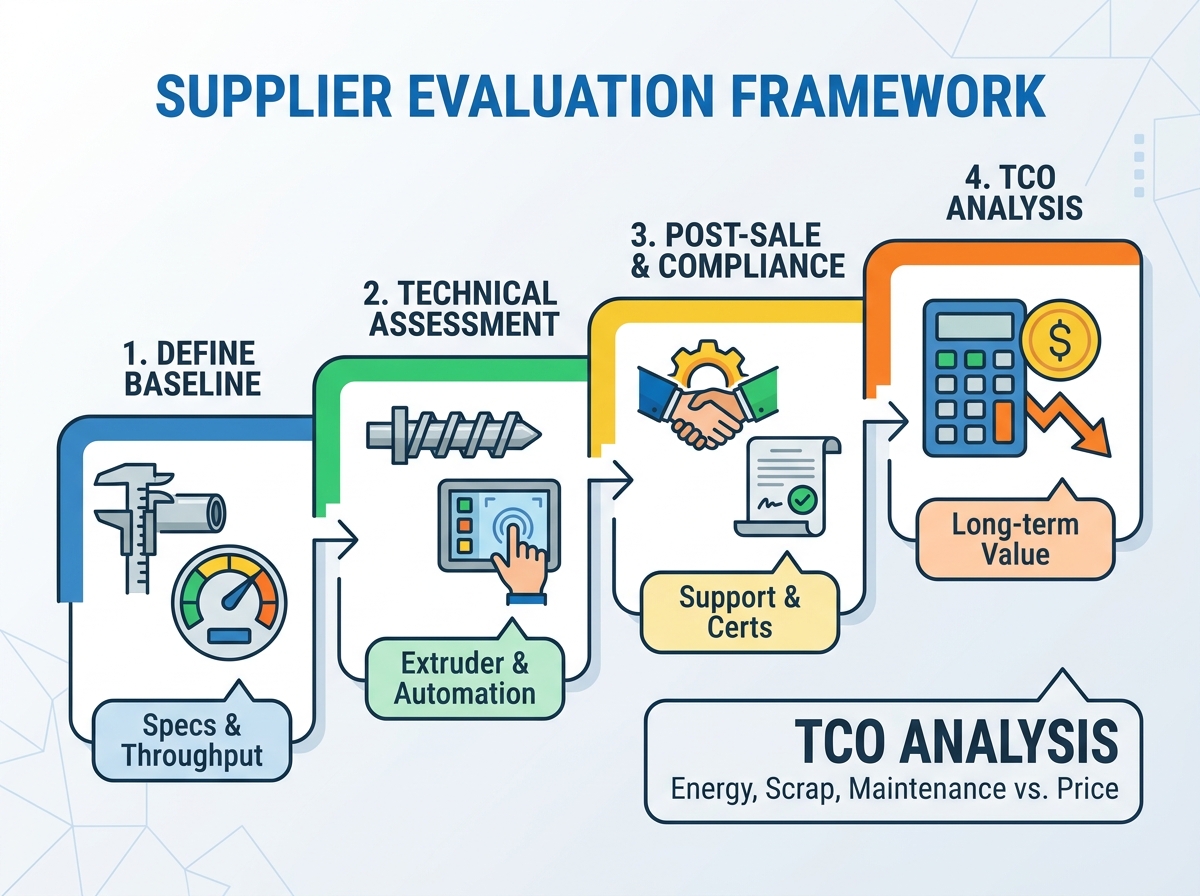
You must transition from reviewing glossy marketing brochures to inspecting technical realities. The equipment's physical build quality dictates your future operational stability. Do not accept vague performance claims. Demand specific engineering tolerances from the manufacturer.
Extruder and Screw Design: Assess the Length-to-Diameter (L/D) ratio carefully. Evaluate the specific screw geometry. Proper design ensures optimal plasticization of the polymer. It guarantees a consistent coating thickness across the entire conduit length. An L/D ratio of 25:1 or 28:1 typically provides the necessary mixing time for standard PVC. For harder compounds, you might need a longer barrel.
Tension Control and Haul-Off: Evaluate the precision of the payoff and haul-off units. Inconsistent tension inevitably leads to metal core breakage. It also causes uneven jacketing and unacceptable product defects. High-quality lines use synchronized dancers and accumulators. They keep the metal core perfectly taut before it enters the crosshead die.
Cooling Infrastructure: Review the complete cooling trough length. Examine the water circulation efficiency. The cooling capacity directly dictates your maximum possible line speed. Inadequate cooling compromises PVC adhesion. It ruins the final surface finish and causes the jacket to shrink irregularly once spooled. Ensure the trough features multiple temperature zones to prevent thermal shock to the plastic.
Automation & HMI: Look for modern, centralized control systems. Insist on a programmable logic controller (PLC) paired with an intuitive touchscreen interface. This setup allows operators to save specific product recipes. It provides real-time monitoring of heating zones and enables straightforward fault diagnostics when issues arise.
Extrusion Technology Feature Comparison Chart
Technical Component | Basic Machine Standard | Advanced Line Standard |
|---|---|---|
Screw Design | Single-stage, generic L/D ratio | Custom geometry tailored for LSZH/PVC |
Tension Control | Manual friction brakes | Automated dancers with VFD synchronization |
Cooling Trough | Single temperature zone | Multi-zone gradient cooling system |
Operating Interface | Analog dials and relays | Centralized PLC with recipe memory |
Many buyers experience sudden abandonment after delivery. You must address this common point of failure aggressively. The true test of a flexible conduit PVC machine supplier happens after the equipment lands on your factory floor. Heavy machinery requires ongoing relationship management.
Installation & Commissioning: Determine if the vendor provides on-site engineer deployment. You need their experts present for the initial setup. They must lead the site acceptance testing (SAT) to prove the line works in your specific facility environment. Remote assistance rarely suffices for complex extrusion lines.
Operator Training: Verify the exact scope of the training curriculum. It must cover daily operation protocols and routine maintenance schedules. It should also include intensive troubleshooting scenarios for your shift operators. Proper training minimizes user error during the critical first month of production.
Spare Parts Availability: Demand a critical spare parts list upfront. Verify guaranteed shipping windows for these replacement components. Heating bands, solid-state relays, specific screw profiles, and proprietary sensors will eventually fail. You need firm assurances they can ship replacements rapidly to prevent extensive factory downtime.
The machinery must mitigate legal and operational risks on your production floor. It also needs to produce sellable, market-compliant products consistently. Failing to verify these standards exposes your business to regulatory fines and rejected shipments.
Machine Certifications: Require hard proof of localized machinery safety standards. Verify electrical compliance for your specific region. Look for a legitimate CE mark or UL-listed electrical panels. Ensure the factory operates under strict ISO 9001 manufacturing protocols. Ask for documentation proving the electrical components source from reputable global brands rather than unverified local markets.
End-Product Capabilities: Confirm the line can maintain strict dimensional tolerances. The finished PVC coated flexible conduit must pass rigorous industry testing. It needs to meet ingress protection (IP) ratings perfectly. It must also pass fire retardancy standards applicable to your target market. Request historical test data from the manufacturer showing previous machines achieving these exact certifications.
This framework provides a concrete action plan. You will use it to narrow down your choices to the final two or three vendors. Partnering with a reliable flexible conduit PVC machine supplier requires strict verification steps. Never skip the final validation phases before authorizing a large payment.
Requesting References: Ask for detailed case studies. Request direct contact information for facilities currently running the equipment. Call these references directly. Ask them about real-world machine uptime. Inquire about how fast the vendor responds to emergency service calls.
Sample Run Demands: Insist on sending your actual raw metal conduit to their facility. Provide your preferred PVC compound. Demand a fully documented test run using your exact materials. This step eliminates the excuse that your material behaves differently than their standard testing polymer.
Factory Acceptance Test (FAT): Outline your requirements for a rigorous FAT. Do this before making the final payment or authorizing shipment. The vendor must demonstrate all speed and quality metrics live. You or a trusted third-party inspector should attend this test in person.
FAT Inspection Criteria Checklist
Inspection Category | Specific Verification Metric | Pass/Fail Status Indicator |
|---|---|---|
Speed & Throughput | Achieves target meters per minute without jacket tearing | Must hold speed for 60 continuous minutes |
Dimensional Accuracy | Outer diameter remains within ±0.1mm tolerance | Measured via inline laser micrometer |
System Interlocks | Emergency stops instantly halt all motor drives | Verified manually during active extrusion |
Adhesion Quality | PVC jacket resists manual stripping off the metal core | Physical peel test post-cooling |
Choosing a manufacturing partner remains a strategic partnership. It is never a simple transactional purchase. Verifying technical specifications protects your facility from frequent breakdowns. Insisting on a strict Factory Acceptance Test protects your capital expenditure budget. Formalize your specification sheet into a detailed Request for Quote (RFQ) today. Begin your vendor outreach using the objective criteria we outlined above. You now have the exact tools necessary to make an informed, highly secure equipment investment.
A: Standard manufacturing timelines usually range between 60 and 120 days. This timeframe depends heavily on your required level of customization. Complex extrusion lines requiring specialized heating zones or advanced automation panels generally push delivery toward the longer end of this spectrum.
A: Yes, but you must account for hardware changes. A single machine requires different extrusion dies, distinct pin setups, and modified cooling parameters to switch between standard coating and heavy-duty liquid-tight profiles successfully.
A: Buying a complete turnkey line is highly recommended. Integrating a new extruder into an older existing setup introduces severe synchronization risks. Turnkey systems guarantee that payoff, extrusion, and haul-off speeds communicate flawlessly through a unified PLC.
A: Shipments usually operate under standard B2B incoterms like FOB (Free on Board) or CIF (Cost, Insurance, and Freight). Always insist the supplier uses heavy-duty, moisture-sealed wooden crating. This protects sensitive electrical panels and touchscreen interfaces from corrosive sea air.


