

close
Choose Your Site
Global
Social Media
Views: 168 Author: Site Editor Publish Time: 2026-07-23 Origin: Site


For engineers and procurement teams, specifying conduit goes far beyond basic cable management—it is about ensuring ultimate environmental survivability. When flexible metal systems fail in harsh environments, the culprit is rarely the core steel itself. Instead, failures usually stem from the rapid degradation or complete delamination of the outer protective jacket. Understanding exactly how manufacturers bond the PVC jacket to the corrugated steel core is critical for your success. This deep knowledge helps you evaluate supplier quality and prevent costly systemic failures. A poorly applied coating traps moisture, accelerates destructive galvanic corrosion, and voids essential safety compliance entirely. This guide details the industrial application process for stainless steel flexible conduit PVC coating. We will highlight the specific manufacturing markers determining long-term performance. You will also learn how to verify regulatory compliance and maximize your overall project success effectively.
Process defines performance: Vacuum extrusion is the industry standard for flexible conduit, ensuring a tight, gap-free bond that maintains dynamic flexibility.
Adhesion is the primary failure point: Proper pre-cleaning and primer application separate commercial-grade conduits from cheap, shrink-wrapped alternatives.
Specification metrics matter: Evaluating a supplier requires verifying mil-thickness, UV resistance ratings, and operating temperature thresholds (-20°C to +80°C standard, higher for specialized mixes).
Material pairing: The integrity of the final product relies heavily on combining the right grade of stainless steel (typically 304 or 316L) with virgin (not recycled) PVC compounds.
Engineers often underestimate the severe operational impact of conduit jacket failures. A compromised jacket does not just look bad; it actively destroys the internal electrical system. Knowing what causes these failures helps you write better project specifications.
Delamination poses a massive risk to heavy industrial infrastructure. Moisture ingress between the external PVC jacket and the internal steel core creates a highly destructive micro-environment. When water penetrates a loose jacket, it cannot evaporate. It remains trapped directly against the metal surface. This confined moisture accelerates deep pitting and severe galvanic corrosion. Eventually, the structural integrity of the conduit collapses entirely.
We frequently see extensive electrical shorts in petrochemical plants caused solely by trapped condensation inside poorly coated conduits. You simply cannot afford to overlook how manufacturers bond these critical materials. Furthermore, the corrosion inevitably spreads to the termination fittings. When rust compromises the fittings, the entire raceway loses its structural grounding. This creates a severe arc-flash hazard. Proper coating methodology prevents this dangerous chain reaction from ever starting.
Coating integrity directly impacts Ingress Protection (IP) ratings. Strict compliance is non-negotiable for high-risk environments. Municipal facilities, food-processing plants, and wastewater treatment centers demand strict IP66, IP67, or NEMA 4X compliance. These stringent ratings guarantee the conduit can withstand high-pressure water jets and prolonged submersion.
If a jacket tears or separates, the conduit instantly loses its liquid-tight seal. This failure exposes sensitive internal wiring to high-pressure washdowns. It allows highly corrosive cleaning chemicals to reach the copper wires. Non-compliance leads to severe safety hazards, failed inspections, and costly legal liabilities. Ensuring a flawless coating bond keeps your facility compliant with National Electrical Code (NEC) standards. It ensures your infrastructure passes rigorous third-party safety audits without delays.
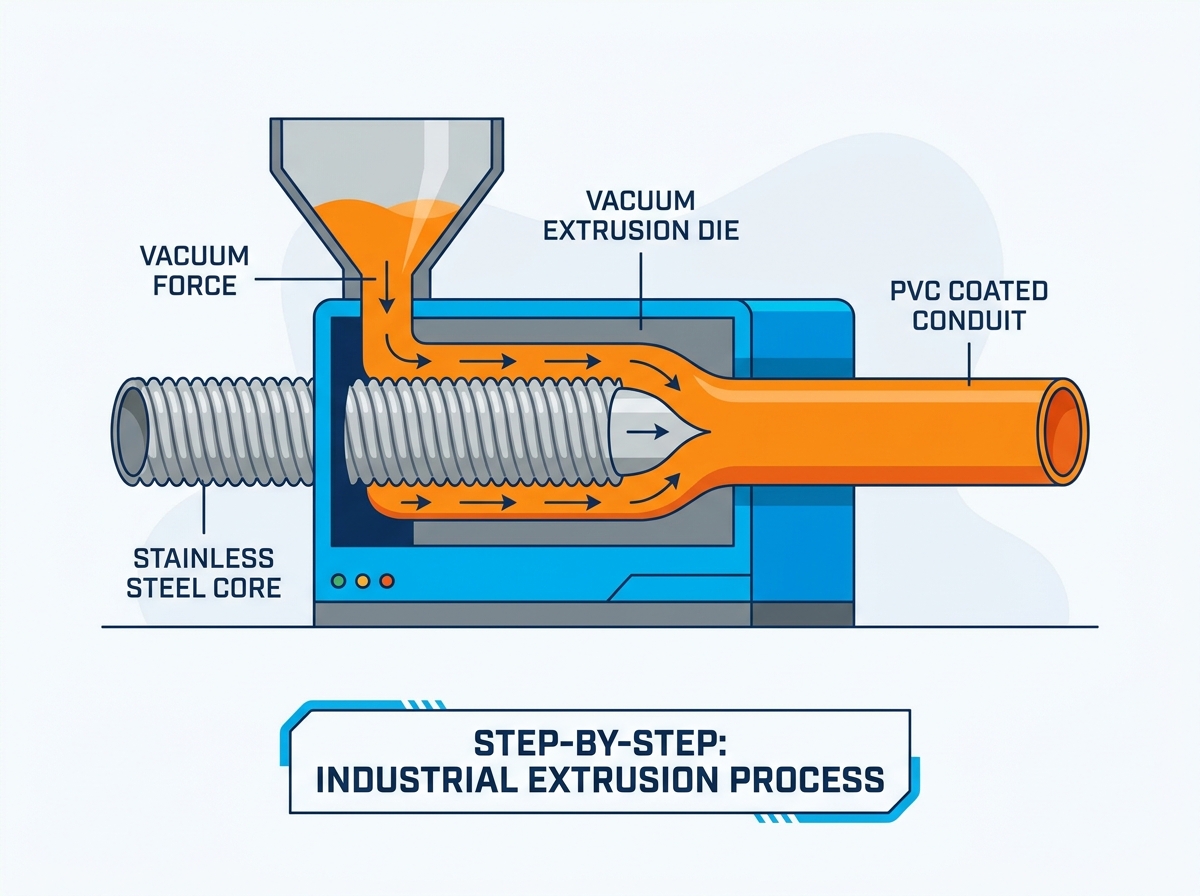
We must explore the exact manufacturing steps required to produce industrial-grade protection. High-quality production relies on a highly controlled, multi-stage sequence. If you want to know exactly how the flexible metal conduit machine works, you must understand these four distinct stages in detail.
Manufacturers must first remove all residual manufacturing oils from the metal core. Bare stainless steel conduit often carries heavy particulates from the initial corrugation process. Factory teams use specialized, heated degreasing solvents to strip these impurities away completely.
A thoroughly cleaned surface is absolutely non-negotiable. Any leftover lubricants or metal shavings will guarantee poor adhesion during the polymer phase. We always warn engineers that skipped cleaning steps are the leading cause of premature jacket peeling. The steel must achieve a pristine, microscopically rough surface to accept the chemical primer properly.
Once clean, automated sprayers apply specialized chemical bonding agents directly to the steel substrate. These liquid primers act as a critical chemical bridge. They prepare the bare metal surface to receive the hot polymer phase efficiently.
Without this chemical layer, the PVC would only sit passively on top of the steel. The primer triggers a cross-linking reaction. It ensures a permanent mechanical and chemical bond between two fundamentally different materials. High-end manufacturers carefully monitor the ambient humidity during this step. Excessive moisture in the factory air can ruin the primer's chemical activation.
The primed core is then pulled mechanically through a highly calibrated, heated extrusion die. During this precise stage, heavy-duty vacuum systems play a vital structural role. The vacuum aggressively draws the heated, semi-liquid PVC compound tightly into the deep corrugations of the metal core.
Why does this vacuum process matter so much? It creates distinct structural advantages:
It actively prevents trapped air pockets from forming beneath the plastic.
It ensures completely uniform wall thickness across every single peak and valley of the steel.
It allows the finished conduit to bend freely along its natural radius.
It guarantees the jacket will not stretch, tear, or detach during complex, tight-angle installations.
Without a strong vacuum, the PVC merely bridges across the peaks of the corrugation. This leaves hollow air gaps in the valleys, drastically reducing crush resistance.
The final manufacturing step involves a rapid water-quench process. The newly coated conduit passes continuously through a chilled water bath. This rapid cooling instantly solidifies the molten PVC.
Quenching locks in the polymer's structural memory. It effectively prevents any unwanted shrinkage or warping as the material transitions to a solid state. Proper curing guarantees the jacket remains dimensionally stable for decades. If the water bath is too warm, the PVC cools unevenly, leading to a wavy, structurally compromised outer surface.
Not all protective coatings offer the same durability. We must evaluate specific manufacturing material choices carefully. These internal choices directly dictate the final environmental survivability of the electrical raceway.
Reputable manufacturers exclusively use virgin PVC compounds for their extrusion processes. Virgin materials deliver vastly superior UV resistance for outdoor applications. They also provide highly predictable tensile strength and dynamic flexibility.
In sharp contrast, cheap alternatives often rely on regrind or recycled plastics. Recycled PVC suffers from heavily inconsistent chemical resistance. Because it contains degraded polymer chains, it becomes brittle much faster over time. It remains highly prone to cracking under physical stress or freezing temperatures. Specifying virgin materials prevents premature jacket cracking in harsh winter conditions.
Industry standards typically dictate specific coating thicknesses, often requiring a baseline 40-mil jacket. However, simply achieving a 40-mil average is not enough to guarantee reliable protection. The true test of manufacturing expertise lies in absolute consistency.
The PVC must maintain strict thickness tolerances evenly across the peaks and valleys of the steel corrugation. Uneven thickness creates hidden weak points. These microscopic thin areas will easily rupture during heavy cable pulling or routine maintenance. A high-quality manufacturer uses continuous laser-caliper monitoring to ensure the thickness never deviates from the acceptable tolerance band.
Manufacturers blend specific chemical additives into the raw PVC to meet precise industrial outcomes. Flame retardants, advanced UV stabilizers, and heavy-oil-resistant compounds alter the polymer's performance profile entirely. You must align these specific additives with your actual operational environment.
Standard PVC Coating Performance Matrix
Additive Type | Primary Protective Benefit | Ideal Industrial Application |
|---|---|---|
UV Stabilizers (Carbon Black) | Prevents solar degradation and chalking. | Outdoor solar farms and rooftop HVAC. |
Flame Retardants (Halogen-Free) | Reduces smoke toxicity during facility fires. | Underground transit systems and hospitals. |
Plasticizers (Cold-Weather) | Maintains flexibility below freezing temperatures. | Arctic drilling rigs and cold storage. |
Oil-Resistant Polymers | Prevents jacket swelling when exposed to lubricants. | Automotive manufacturing and machine shops. |
Budget-focused procurement often leads to disastrous field failures. You must know exactly what manufacturing defects to watch out for. Identifying poor manufacturing quality early saves immense operational frustration.
Some substandard products feature PVC that is merely sleeved over the steel. The manufacturer never actually bonded the materials together chemically. As a result, the loose jacket freely slides backwards during cable pulling.
It bunches up during installation and leaves the metal ends completely exposed to the elements. This defect defeats the entire purpose of specifying a liquid-tight system. A loose jacket also makes the conduit impossible to terminate properly, as the fitting cannot grip a sliding plastic sleeve.
Extrusion machines require extremely precise temperature controls. Poor thermal regulation during the coating process leads to microscopic, invisible defects. Tiny pinholes and micro-tears form deep in the jacket structure.
These tiny breaches immediately compromise the IP rating. Water will inevitably find its way inside through capillary action. Best practices dictate that inspectors should perform underwater air-pressure tests to detect these invisible pinholes before installation begins.
Even a perfectly coated conduit remains vulnerable at its termination points. Field technicians must properly strip the protective coating to attach the metal termination fittings. If they use incompatible metals for these fittings (such as cheap galvanized zinc on a 316 stainless core), severe galvanic reactions will occur rapidly.
Moisture acts as an electrolyte between the mismatched metals, eating away the fitting threads within months. Always ensure your fittings match the exact stainless steel grade of the core conduit. Furthermore, technicians must use approved liquid-tight sealing compounds to protect the stripped termination edges completely.
Selecting the right supplier requires diligent, evidence-based verification. We strongly recommend using a strict qualification checklist for every vendor. This structured approach ensures you only partner with highly capable manufacturers.
Never accept verbal promises regarding coating durability. Always ask suppliers for comprehensive Salt Spray Test (ASTM B117) results. This standardized test proves the material can survive corrosive environments. Demand explicit Adhesion Test documentation to verify the bonding strength between the PVC and the steel. A reputable supplier will eagerly provide these third-party laboratory reports.
Ensure the supplier explicitly specifies the exact metallurgical grade of stainless steel underneath the PVC. You must typically choose either 304 or 316L. Grade 316L is absolutely non-negotiable for marine applications or heavy-corrosive environments like chemical plants. The plastic coating alone cannot protect against everything; if the jacket gets nicked by a forklift, the underlying steel must survive the exposure.
Check if the manufacturer can seamlessly adjust their PVC formulation to meet unique project demands. High-quality factories should offer low smoke zero halogen (LSZH) options for enclosed spaces. They should also possess the capability to color-code the extrusion to meet specific facility safety identification standards.
Verify the supplier’s ability to provide batch-tested material certifications. These trace documents are mandatory for securing municipal projects or high-level government contracts. Proper traceability ensures that if a defect occurs in the field, the manufacturer can track the failure back to a specific production shift. If you have specific engineering questions regarding your next heavy-duty project, do not hesitate to contact our team for detailed technical guidance.
The application of PVC to stainless steel flexible conduit remains a highly exact science. The specific extrusion process directly dictates the product's ultimate field survival. You must prioritize verifiable manufacturing quality over initial unit costs to protect your infrastructure successfully.
Here are your critical action-oriented next steps:
Do not evaluate protective conduit based on basic price-per-foot metrics alone. Always look closely at the underlying technical data.
Base all purchasing decisions on verified vacuum extrusion processes and comprehensive material safety data sheets.
Demand structural adhesion quality reports and ASTM salt-spray results before signing any bulk procurement contract.
Request detailed technical spec sheets and physical material samples from your shortlisted suppliers to inspect the bond yourself.
Consult directly with professional engineering teams to match custom PVC formulations to your specific environmental and regulatory demands.
A: Extrusion forms a permanent mechanical and chemical bond. Machines use a powerful vacuum to pull hot PVC into the steel corrugations, preventing any movement. Shrink-wrapping merely applies a loose, unbonded physical layer over the steel. This shrink-wrapped jacket remains highly prone to slipping, tearing, and bunching during field installation.
A: No, proper vacuum extrusion maintains the original bend radius of the steel core. By pulling the PVC tightly into the natural corrugations, the conduit bends freely. However, poorly applied, overly thick, or non-vacuumed coatings can severely stiffen the conduit and restrict necessary mechanical movement.
A: Standard industrial PVC coatings typically operate safely between -20°C and +80°C. If your facility experiences extreme ambient heat or freezing conditions, manufacturers can create specialized PVC formulations. These custom plasticizer mixes significantly extend the safe operating temperature range without risking brittleness.
A: Yes, but you must specify heavy-duty, reinforced jackets engineered specifically for this purpose. Standard coatings may degrade underground due to soil chemicals. Furthermore, you must pair the conduit with proper IP67 or IP68 liquid-tight fittings. This strictly ensures ground moisture cannot penetrate the metal termination points.


