

close
Choose Your Site
Global
Social Media
Views: 126 Author: Site Editor Publish Time: 2026-08-03 Origin: Site


Manufacturers seeking to expand electrical conduit product lines face distinct equipment investments. You must choose the right machinery to secure a competitive edge. The decision often hinges on whether to produce basic components or fully finished, specialized products. While often framed as a comparison, these machines perform complementary steps in manufacturing Liquid-Tight Flexible Metal Conduit (LFMC). Producing the bare metal requires mechanical precision. Adding a polymer jacket demands advanced thermal expertise. We will objectively compare the capital expenditure (CapEx), operational requirements, and return on investment timelines of forming equipment versus plastic coating extrusion systems. You will learn how to evaluate these technologies based on facility constraints and market demand. Ultimately, this guide helps you determine the most profitable integration strategy for your production floor.
Complementary Functions: Forming machines produce the bare interlocking metal core; a conduit coating machine applies the weather-resistant polymer jacket.
Investment Phasing: Upgrading an existing bare-metal line with a coating machine offers a faster path to high-margin, liquid-tight markets than building a full line from scratch.
Operational Complexity: Forming relies on precise mechanical tension and strip profiling; coating relies on thermal regulation and continuous extrusion pressure.
Facility Requirements: Inline integration of both systems requires significant floor space, synchronized speed controls, and advanced cooling infrastructure.
You face a fundamental business problem when planning production capacity. You must decide whether to capture market share in standard flexible metal conduit (FMC) or invest heavily to meet high-end liquid-tight (LFMC) specifications. These two product categories require entirely different manufacturing approaches. Standard FMC serves indoor, dry environments. LFMC serves harsh, wet, or corrosive industrial environments.
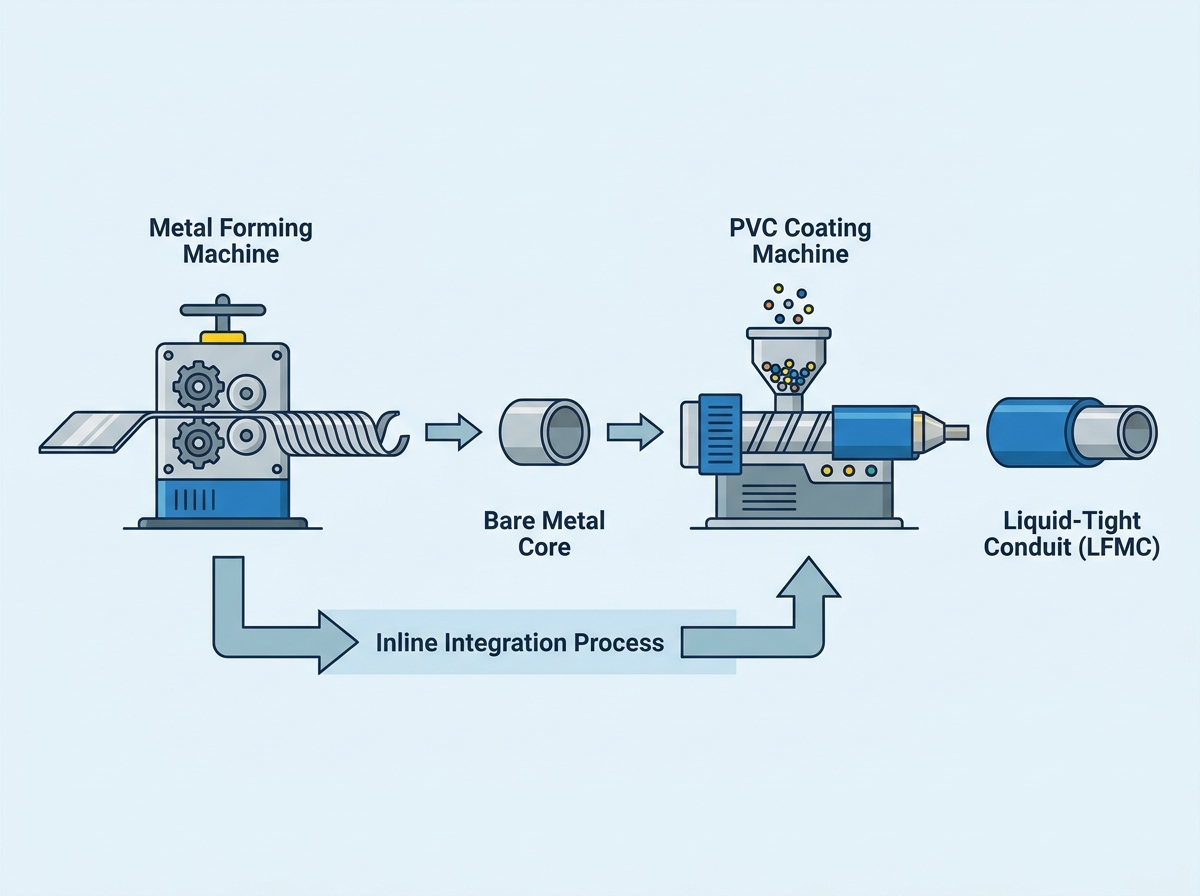
The flexible metal conduit forming machine plays the foundational role. It converts galvanized steel or aluminum strips into continuous flexible tubing. This mechanical process dictates the crush resistance and flexibility of your final product. Operators must configure the machinery for specific profiles, such as Square-lock for general-purpose routing or Interlock for heavy-duty protection. If you want to understand the intricate mechanical sequencing, learning how a flexible metal conduit machine works reveals the critical importance of strip tensioning.
The conduit coating machine plays an entirely different role. It extrudes a uniform PVC, PU, or PE layer over the bare metal core. This layer dictates the environmental protection rating, such as IP66 or IP67. It also provides essential chemical resistance for outdoor installations. The plastic jacket transforms a simple metal tube into a highly weather-resistant protective channel.
Integration approach matters significantly for production efficiency. You must assess whether to run these as decoupled batch processes or a continuous synchronized line. Decoupled processes operate offline, giving you flexibility. Synchronized lines operate inline, demanding precise speed matching. Both methods carry distinct operational trade-offs.
Forming machinery requires rigorous mechanical oversight. The success criteria for these systems remain straightforward. You need consistent production speed, minimal strip jamming, and strict adherence to internal diameter (ID) and outer diameter (OD) tolerances. Minor deviations in the metal strip can cause immediate binding. Therefore, precision engineering defines a quality forming machine.
We must evaluate key technical dimensions when shortlisting forming equipment. You should pay close attention to the following aspects:
Profile Tooling: Operators need the ability to swap dies easily. Transitioning between Square-lock and Interlock configurations should take minimal time. Quick-change tooling reduces costly machine downtime.
Material Handling: You must consider the payload capacity for raw steel coils. Automated tensioning systems prevent strip deformation before it enters the forming head. Proper tension ensures a uniform interlock structure.
Wear Parts: The lifespan of forming rollers heavily impacts your maintenance budget. You must evaluate the frequency of required calibrations. High-grade steel rollers resist wear and maintain tight tolerances longer.
Cost considerations for forming machines lean heavily toward mechanical upkeep. They typically consume less energy compared to thermal extrusion setups. However, they incur higher mechanical maintenance costs. Bearings, rollers, and dies require frequent lubrication and occasional replacement. You must budget for these ongoing mechanical wear items.
Adding a polymer jacket introduces complex thermal dynamics to your facility. The success criteria shift from purely mechanical tolerances to material science. You need seamless jacket adhesion and zero-pinhole extrusion. Furthermore, the final product requires strict compliance with electrical safety standards, such as UL 360. Any gaps in the plastic jacket will cause product failure.
Key technical dimensions for extrusion equipment focus heavily on polymer processing. The extruder screw design plays a vital role. Manufacturers use specific L/D (Length to Diameter) ratios optimized for standard PVC. They may need different ratios for specialized low-smoke zero-halogen (LSZH) compounds. You must match the screw geometry to your intended raw material.
Thermal stability directly influences jacket quality. Multi-zone temperature controls prevent polymer degradation. They also prevent uneven jacket thickness. If temperatures fluctuate, the plastic will not flow smoothly over the metal core. Consistent heat application guarantees a uniform protective layer.
Cooling infrastructure represents another major technical dimension. Extruded plastic remains soft and highly malleable as it exits the die head. The length and efficiency of the water cooling flume determine how quickly the jacket solidifies. You must cool the conduit completely before coiling it. Otherwise, the hot plastic will deform or stick to itself on the spool.
The ROI factor for this equipment upgrade remains highly attractive. A dedicated polymer coating line opens access to higher-margin sectors. You can immediately target industrial, marine, and outdoor electrical infrastructure markets. These sectors routinely demand LFMC and pay a premium for certified liquid-tight protection.
Process Dimension | Core Forming Machine | Extrusion Coating Machine |
|---|---|---|
Primary Energy Draw | Electric motors, mechanical drives | Heating zones, chiller units, extruders |
Critical Variables | Strip tension, roller alignment | Melt temperature, line speed, cooling rate |
Downtime Risks | Material jams, die wear | Polymer degradation, die head burn-out |
Operator Skillset | Mechanical calibration | Thermal dynamics, plastics rheology |
Integrating new machinery always impacts your existing facility footprint. Inline configurations require exceptionally long, straight-line floor space. You must accommodate the forming head, the extruder, a lengthy cooling bath, haul-off tractors, and the final coiler. Many standard facilities lack the linear square footage required for a continuous inline setup.
Synchronicity risks pose a major challenge for continuous production. In an inline setup, both machines must communicate perfectly. If a jam occurs in the forming section, the metal core stops moving. Consequently, it will halt the extruder. This stoppage potentially causes material burn-out in the die head. Managing these speed differentials requires advanced accumulator systems and programmable logic controllers (PLCs).
Material waste also impacts your daily operations. Extruders require specific purge times. Operators must calibrate the thermal profile during startup. This process leads to inevitable material waste known as the scrap rate. To minimize this waste, you must plan long, uninterrupted production batches. Frequent color changes or material swaps will destroy your profit margins.
Workforce expertise requires a dual approach when running both systems. You cannot rely on a single type of technician.
Forming Expertise: This stage requires mechanical technicians. They understand metalworking, tension calibration, and physical tolerances.
Coating Expertise: This stage requires plastics extrusion operators. They understand thermal dynamics, rheology, and cooling rates.
You must invest in cross-training or hire specialized personnel for each manufacturing phase. Bridging this skills gap ensures smooth daily operations.
Choosing your next equipment upgrade requires a clear assessment of your current market position. You can evaluate your strategic options through two distinct scenarios. Scenario A focuses on expanding capability. If you already produce bare FMC, adding a standalone coating machine represents the logical next step. It allows you to double your catalog offerings quickly. You can serve both indoor and outdoor markets from a single facility.
Scenario B focuses entirely on volume scaling. Perhaps bare FMC demand outpaces your current supply. In this case, investing in higher-speed, dual-head forming machines yields a faster return. You should maximize your core output before adding complex coating lines. Scaling your primary product often delivers immediate cash flow benefits.
Once you define your strategy, you must vet equipment suppliers rigorously. A strong vendor evaluation checklist protects your capital investment. You should follow these practical steps during your procurement phase:
Demand transparent Overall Equipment Effectiveness (OEE) data from the manufacturer.
Verify spare part availability and demand clear local technical support SLAs.
Request physical sample runs using your specific raw materials, including your steel grade and preferred PVC compound.
Do not skip the sample run phase. Verifying machine performance with your exact materials eliminates expensive surprises upon delivery. If you need specialized guidance on equipment configurations, you should contact us to discuss your facility's unique parameters.
Selecting the right production machinery requires more than a simple comparison of features. The choice isn't just about selecting machine A versus machine B. You must align your equipment capabilities directly with your target buyer's compliance requirements. Meeting standards like UL 360 dictates the technology you must deploy on the floor.
Upgrading existing forming lines with extrusion capabilities accelerates entry into high-margin markets.
Continuous inline production demands strict speed synchronization and extended floor layouts.
Operators must balance mechanical tensioning expertise alongside complex thermal plastics processing skills.
Rigorous vendor vetting and material sample runs remain non-negotiable for securing your CapEx investment.
Always factor in your localized operational expenses before making a final decision. You must analyze local energy costs and raw material supply chains carefully, as extruders consume significant electrical power for heating and cooling. We encourage all operators to audit their current floor space and engineering expertise thoroughly before requesting formal vendor quotes.
A: Yes. Inline systems exist, but they require precise synchronization. Manufacturers use accumulator systems to manage the speed differences between the mechanical forming head and the continuous plastic extruder. This ensures the line remains stable even during minor speed fluctuations.
A: Assuming a standard extrusion cross-head, changing the die and pin typically takes an experienced operator 30 to 60 minutes. This timeframe also includes recalibrating the line speed and allowing the thermal zones to stabilize for the new material thickness.
A: Yes. It requires a dedicated chilled water circulation system. Operators must use a stainless-steel cooling flume to quickly set the extruded plastic. Rapid cooling prevents the jacket from deforming or flattening during final coiling onto the spool.
A: Generally, a high-quality coating line requires a larger CapEx than a standard bare-metal forming machine. The extrusion line includes the extruder, cross-head, lengthy cooling bath, and haul-off unit. It also involves highly complex thermal and automated control systems.


