

close
Choose Your Site
Global
Social Media
Views: 156 Author: Site Editor Publish Time: 2026-08-14 Origin: Site


Investing in a complete production line requires a delicate balance. You must maximize output speed while ensuring strict product compliance. Meeting global ANSI standards and demanding IP ratings remains non-negotiable. Finding this equilibrium separates highly profitable manufacturing operations from those constantly battling quality rejects. Today, demand for Liquidtight Flexible Metal Conduit (LFMC) is soaring rapidly. Industrial sectors, renewable energy setups, and commercial construction sites require massive volumes. This surge necessitates reliable, high-yield manufacturing systems. Relying on piecemeal machinery simply cannot keep up with modern market demands. Integrating disparate machines often leads to production bottlenecks. You will experience higher material waste and inconsistent jacketing. We designed this comprehensive guide to provide a realistic evaluation framework. You will learn how to select, procure, and implement a synchronized setup successfully. We will help you navigate complex vendor specifications clearly. You can use these insights to streamline operations and avoid falling for inflated capacity claims.
A complete line requires synchronized integration between the metal core forming machine and the plastic extrusion unit to prevent material waste.
Production capacity must be evaluated based on continuous stable output, not just theoretical peak speeds.
Compliance with global electrical standards (like ANSI/UL) dictates the required precision of the line’s extrusion die and cooling mechanisms.
Total Cost of Ownership (TCO) relies heavily on regional availability of replacement parts and post-installation operator training.
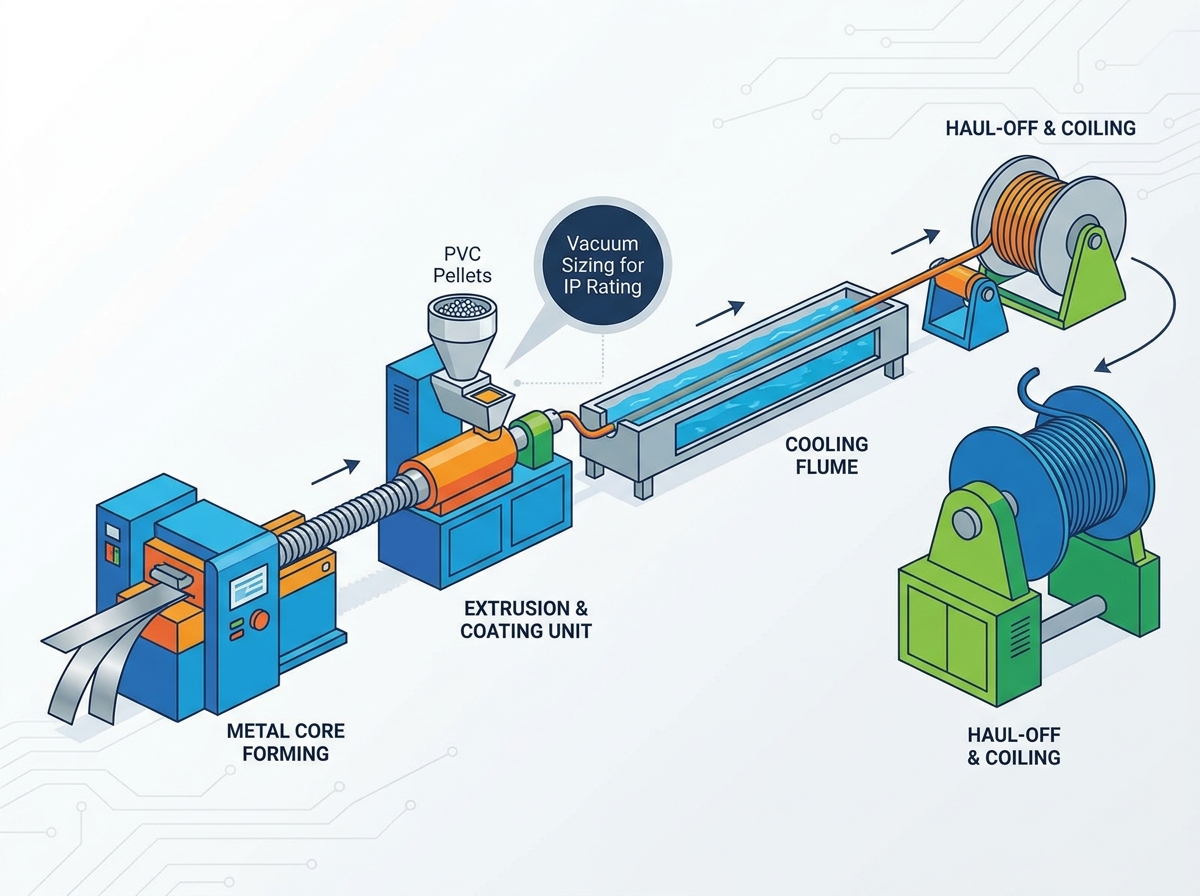
A high-yield setup combines several distinct manufacturing stages into a unified workflow. Each stage depends heavily on the successful execution of the previous step. We can break down the primary sequence into four major sections.
Metal Strip Profiling and Lock-Forming: The process begins with raw galvanized steel or aluminum strips. The machine profiles and winds the metal strip into a continuous corrugated core. Tension control remains absolutely critical here. A sudden drop in tension causes irregular lock formations. You must evaluate the machine's ability to produce specific profiles reliably. Most industrial applications require either square-lock or interlock geometries. Interlock profiles offer superior tensile strength for heavy-duty environments.
Extrusion and Coating Unit: The formed metal core enters the crosshead die of the extruder. Here, the machinery applies a protective thermoplastic jacket over the metal. Screw design plays a massive role in this step. Proper screw geometry ensures uniform plastic melting inside the barrel. This uniformity guarantees consistent jacket thickness. Consistent thickness prevents weak spots in the final flexible conduit.
Cooling Flume: Immediately after extrusion, the hot conduit enters a long water bath. Precise temperature control in this flume stops the plastic from shrinking uncontrollably. Sudden temperature drops can shock the material. This shock causes severe adhesion failures between the metal core and the plastic jacket. Gradual cooling ensures mechanical stability.
Haul-off and Coiling: A haul-off tractor system pulls the finished conduit through the line. Automated tensioning prevents the metal core from stretching or deforming. Caterpillar tracks typically grip the conduit firmly without crushing it. Finally, an automated coiling unit packages the conduit into neat, marketable rolls.
Integrating components from different vendors often leads to communication errors. Controllers from different brands struggle to sync speeds accurately. You might save money upfront by purchasing a separate former and extruder. However, synchronization failures quickly erase those savings through high scrap rates. Purchasing a turnkey PVC coated flexible conduit production line ensures seamless communication across all modules. The forming unit talks directly to the haul-off tractor. If the former slows down, the extruder adjusts its output automatically. This synchronized loop reduces material waste and keeps daily production continuous.
Manufacturers often advertise theoretical peak speeds on their promotional brochures. Running machinery at maximum capacity constantly degrades mechanical parts. You should evaluate capacity based on continuous, stable output instead. Benchmark the machine's true meters-per-minute rate for specific trade sizes. Factor in routine maintenance intervals when calculating daily production volumes. A machine running stably at lower speeds yields more usable product. Erratic high-speed runs generate massive amounts of rejected conduit.
Here is a baseline reference chart outlining standard manufacturing benchmarks across different conduit sizes.
Conduit Trade Size | Optimal Production Speed (Meters/Min) | Cooling Flume Temperature Target |
|---|---|---|
3/8 Inch | 20 - 25 | 15°C - 20°C |
1 Inch | 12 - 18 | 15°C - 20°C |
2 Inch | 8 - 12 | 12°C - 18°C |
4 Inch | 4 - 6 | 10°C - 15°C |
A single setup rarely handles every possible conduit size without tooling changes. Assess the changeover time required to switch production between standard trade sizes. Moving from a small diameter to a massive four-inch conduit requires effort. Operators must swap forming rollers, extrusion dies, and sizing sleeves. Efficient equipment features quick-change tooling designs to minimize offline hours. Lengthy changeovers eat into valuable production time rapidly. Look for equipment where an experienced technician can complete a full size switch quickly.
Continuous operation puts massive physical stress on motors and gearboxes. Reputable variable frequency drives (VFDs) provide predictable torque control. They adjust motor speeds smoothly without causing destructive power spikes. You must insist on globally recognized VFDs and industrial control systems. Unbranded electronic components fail frequently under heavy manufacturing use. Standardizing on recognized brands ensures you can find replacement parts locally. If you want to dive deeper into the mechanics, you can learn exactly how does the flexible metal conduit machine work to appreciate the critical role of VFDs.
Modern industrial applications require various plastic coatings beyond standard formulations. You might need UV-resistant materials for outdoor solar panel installations. Indoor public spaces often demand low-smoke zero-halogen (LSZH) or flame-retardant grades. Verify the extruder’s ability to handle different polymer types efficiently. A well-designed extrusion screw processes multiple materials without requiring a complete hardware swap. This flexibility allows you to bid on diverse contracts without buying secondary extruders.
Industry certifications act as the gateway to lucrative commercial construction contracts. Standards like ANSI, UL 360, and CE dictate strict physical properties. The specifications of your machinery directly impact your ability to pass these rigorous tests. If the metal former creates loose interlocks, the conduit fails pull-tension tests. If the extruder applies uneven plastic, the product fails cold-bend flexibility tests. Precision equipment removes the guesswork from achieving regulatory compliance.
Liquid-tight performance depends entirely on flawless jacket integrity. Achieving IP67 or IP68 ratings requires a perfect plastic coating over the metal. Air pockets trapped between the metal core and the jacket create severe weak points. High-end extrusion lines utilize powerful vacuum technology inside the crosshead die. The vacuum pulls the molten plastic tightly against the corrugated surface. This process eliminates trapped air completely before the plastic cools. The resulting conduit provides superior protection against water, oil, and chemical ingress.
The coating process requires a delicate balance between adhesion and bendability. The plastic jacket must adhere securely to prevent stripping during field installation. However, excessive adhesion restricts the conduit's natural bend radius. The machine regulates this thermal bonding process through precise heating zones. Proper thermal management ensures the plastic grabs the metal firmly. Meanwhile, the internal metal links can still pivot and flex naturally.
A continuous extrusion line demands significant industrial floor space. You must plan for a linear layout extending up to thirty meters. This massive footprint accommodates the pay-off stand, former, extruder, flume, and coiler. Power supply parameters present another major operational hurdle. These heavy machines require high-capacity, three-phase electrical connections. Furthermore, the cooling flume needs a robust closed-loop water infrastructure. An industrial chiller system maintains the water at optimal temperatures for continuous runs.
Buyers often underestimate the time required to become fully operational. Factory acceptance testing (FAT) ensures the machine meets your specifications initially. This testing happens before the equipment leaves the vendor's assembly floor. Shipping large equipment internationally adds several weeks to the timeline. Once the machinery arrives, on-site assembly and mechanical calibration begin immediately. A realistic timeline spans sixty to one hundred twenty days. Rushing the commissioning phase usually leads to alignment issues and premature component wear.
Complex control screens often intimidate newly hired line operators. A poorly trained operator can cause massive material waste during startup sequences. You must negotiate mandatory vendor-led training into your initial purchase contract. Proper education mitigates early-stage production errors significantly. Operators need extensive hands-on experience setting heating zones and threading the metal core. They must also learn how to adjust haul-off tension correctly.
Sudden machine breakdowns destroy rigid production schedules. You should evaluate vendor service agreements for technical support very carefully. Fast access to troubleshooting experts minimizes your offline hours. Additionally, you must identify high-wear spare parts early in the process. Stocking these specific components on-site prevents minor issues from escalating.
Common high-wear items to keep in your inventory include:
Metal forming rollers and profile dies.
Extrusion crosshead dies and sizing sleeves.
Heating bands for the extruder barrel.
Caterpillar traction belts for the haul-off unit.
The machinery market features many builders making extraordinary performance promises. You should advise skepticism toward manufacturers lacking verifiable industrial case studies. Reputable builders welcome requests to run sample material tests prior to purchase. Ask them to extrude your specific plastic grade over your exact metal profile. Observe the output quality carefully. If a vendor refuses to provide physical samples or operational videos, look elsewhere.
Initial capital expenditure represents only one piece of the financial puzzle. Focus heavily on operational expenditures for a clearer long-term picture. Energy-efficient heating elements reduce monthly industrial power bills dramatically. Synchronized PLC controls minimize scrap output, saving thousands in wasted raw materials. Automated coiling and packaging systems reduce manual labor costs significantly. By factoring in these operational savings, premium machinery yields a faster return on investment.
Before initiating formal vendor negotiations, you need a highly defined strategy. Prepare a comprehensive checklist of exact technical specifications. You must know your desired diameter range and target daily output. Documenting your local power and water standards is also critical. Having these precise numbers ready shows vendors you understand your production needs. When you are ready to discuss specific line configurations, you can easily contact us to align your technical requirements with proven equipment solutions.
Selecting the right production equipment dictates your future manufacturing success. The ideal machinery aligns mechanical precision with your target market's compliance requirements. You must prioritize stable output speeds over theoretical maximums to preserve equipment lifespan. Ensure your chosen setup features synchronized controls to minimize costly material waste. Look for versatile tooling designs to handle multiple conduit diameters efficiently. Finally, take action by requesting detailed technical spec sheets from shortlisted builders. Compare component brands, factory layout drawings, and post-installation support guarantees closely. This diligent comparison guarantees you invest in a truly profitable manufacturing system.
A: Most reputable manufacturers require 60 to 120 days to build a custom extrusion line. This timeframe includes assembling components, programming the controllers, and conducting factory acceptance testing. Freight shipping via ocean freight adds an additional three to six weeks. You should plan your capital purchase at least five months before your target launch.
A: Usually, a single forming unit focuses on one profile type to maintain mechanical stability. Switching between square-lock and interlock requires entirely different roller sets and tensioning calibrations. Many facilities deploy separate forming machines for each core type. They then feed the finished cores into a shared plastic coating unit to maximize efficiency.
A: Modern extruders use vacuum sizing technology inside the crosshead die. As the molten plastic flows over the metal core, a vacuum pulls it tightly against the corrugations. Die head calibration centers the metal core precisely. This prevents the plastic from pooling on one side. The result is a highly uniform, liquid-tight protective jacket.
A: Most builders offer a standard 12-month warranty on structural and mechanical components. This covers the extruder barrel, heavy steel frame, and drive shafts. Electronic components, like VFDs and PLCs, usually carry guarantees directly from their original manufacturers. You should always ask vendors to clarify exactly which consumable parts fall outside the coverage.


